Excel GCD Function
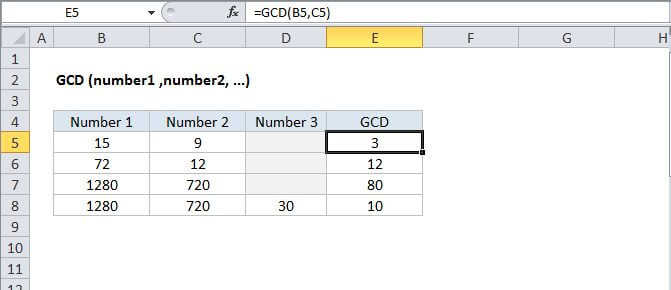
Summary
The Excel GCD function returns the greatest common pisor of two or more integers. The greatest common pisor is the largest integer that goes into all supplied numbers without a remainder. For example, =GCD(60,36) returns 12.
Purpose
Get the greatest common pisor of two or more numbers
Return value
A number representing the largest positive integer that pides the numbers without a remainder
Syntax
=GCD (number1, [number2], ...)
Arguments
- number1 - The first number.
- number2 - [optional] The second number.
Usage notes
Use the GCD function to get the greatest common pisor of two or more integers. The greatest common pisor is the largest positive integer that pides the numbers without a remainder. For example:
=GCD(60,36)
returns the number 12, since 12 is the largest factor that goes into both numbers evenly.
The GCD function can accept up to 255 numbers as arguments.