Excel AVERAGE Function
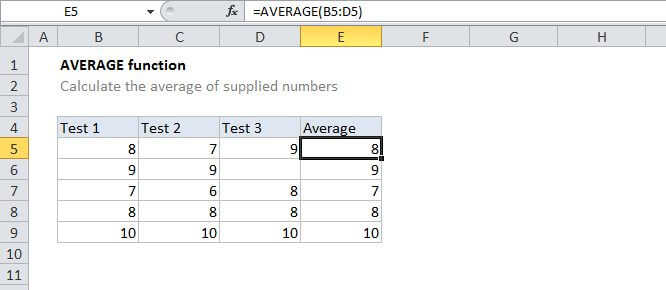
Summary
The Excel AVERAGE function returns the average of values supplied as multiple arguments. AVERAGE can handle up to 255 inpidual arguments, which can include numbers, cell references, ranges, arrays, and constants.
Purpose
Get the average of a group of numbers
Return value
A number representing the average.
Syntax
=AVERAGE (number1, [number2], ...)
Arguments
- number1 - A number or cell reference that refers to numeric values.
- number2 - [optional] A number or cell reference that refers to numeric values.
Usage notes
- The AVERAGE function returns the average (arithmetic mean) of a group of supplied numbers.
- To calculate the average, Excel adds the numbers together and pides by the total number of numbers. For example, AVERAGE (2,4,6) returns 4.
- Numbers can be supplied as numbers, ranges, named ranges, or cell references that contain numeric values. Up to 255 numbers can be supplied.
- The AVERAGE function will automatically ignore empty cells.