Excel AVERAGEIFS Function
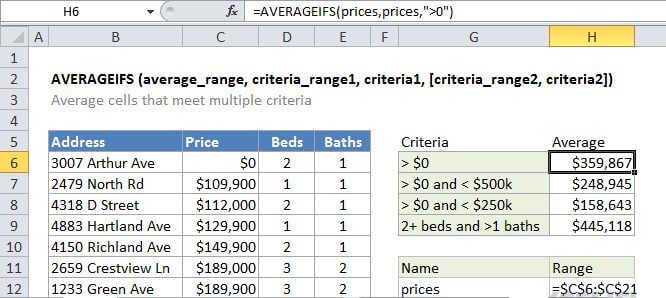
Summary
The Excel AVERAGEIFS function computes the average of the numbers in a range that meet one or more supplied criteria. The criteria in AVERAGEIFS supports logical operators (>,<><>,=) and wildcards (*,?) for partial matching.
Purpose
Average cells that match multiple criteria
Return value
The aveage of the cells that meet all criteria
Syntax
=AVERAGEIFS (avg_rng, range1, criteria1, [range2], [criteria2], ...)
Arguments
- avg_rng - The range to average.
- range1 - The first range to evaulate.
- criteria1 - The criteria to use on range1.
- range2 - [optional] The second range to evaluate.
- criteria2 - [optional] The criteria to use on range2.
Usage notes
AVERAGEIFS averages cells in a range that match supplied criteria. Unlike the AVERAGEIF function, AVERAGEIFS can apply more than one set of criteria, with more than one range. The first range is the range to be averages. The criteria is supplied in pairs (range/criteria) and only the first pair is required. For each additional criteria, supply an additional range/criteria pair. Up to 127 range/criteria pairs are allowed.
Note the order of arguments is different between the AVERAGEIFS and AVERAGEIF functions. The range to average is the first argument in AVERAGEIFS, but the third argument in AVERAGEIF.
Notes:
- AVERAGEIFS returns the #DIV0! error value when no criteria are met
- Each additional range must have the same number of rows and columns as the avg_range.
- Non-numeric criteria needs to be enclosed in double quotes but numeric criteria does not. For example: 100, "100", ">32", "jim", or A1 (where A1 contains a number).
- The wildcard characters ? and * can be used in criteria. A question mark matches any one character and an asterisk matches any sequence of characters.
- To find a literal question mark or asterisk, use a tilde (~) in front question mark or asterisk (i.e. ~?, ~*).