Excel MODE.MULT Function
Summary
The Excel MODE.MULT function returns a vertical array of the most frequently occurring numbers in a numeric data set. For example, =MODE.MULT(1,2,3,3,4,5,5) returns {3:5}.
Purpose
Get most frequently occurring numbers
Return value
Numbers representing mode(s)
Syntax
=MODE.MULT (number1, [number2], ...)
Arguments
- number1 - A number or cell reference that refers to numeric values.
- number2 - [optional] A number or cell reference that refers to numeric values.
Usage notes
The Excel MODE.MULT function returns a vertical array of the most frequently occurring number(s) in a numeric data set. Numbers can be supplied as numbers, ranges, named ranges, or cell references that contain numeric values. The MODE.MULT function will accept up to 254 inpidual arguments.
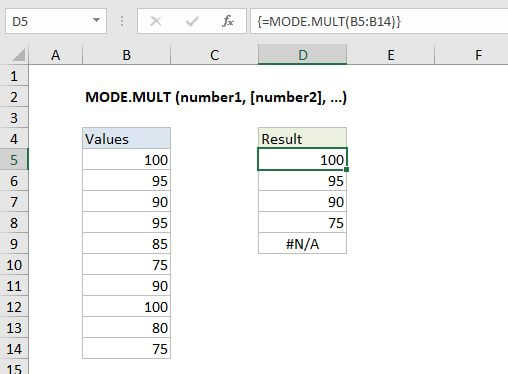
In the example shown, the formula entered in D5:D9 is:
{=MODE.MULT(B5:B14)}Array formula syntax
The MODE.MULT function returns an array of results and must be entered as an array formula:
- Select a vertical range of cells
- Enter MODE.MULT function
- Confirm with control + shift + enter
In each selected cell, MODE.MULTI will return a mode value, if one exists.
Horizontal array
The MODE.MULT function returns results in a vertical array. To return a horizontal array, add the transpose function:
{=TRANSPOSE(MODE.MULT(range))}Notes
- If supplied numbers do not contain duplicates, MODE.MULT will return #N/A
- The MODE function ignores empty cells, and cells that contain boolean values or text.
- Arguments can be numbers, names, arrays, or references.
- MODE.SNGL was introduced in Excel 2010.