Excel RANK.EQ Function
Summary
The Excel RANK.EQ function returns the rank of a number against a list of other other numeric values. When values contain duplicates, RANK.EQ will assign the higher rank to each set of duplicates.
Purpose
Rank a number against a range of numbers
Return value
A number that indicates rank.
Syntax
=RANK.EQ (number, ref, [order])
Arguments
- number - The number to rank.
- ref - An array that contains the numbers to rank against.
- order - [optional] Rank ascending or descending. Default is zero.
Usage notes
The Excel RANK.EQ function will rank a number against a list of other numeric values. It is not necessary to sort the values in the list before using RANK.EQ.
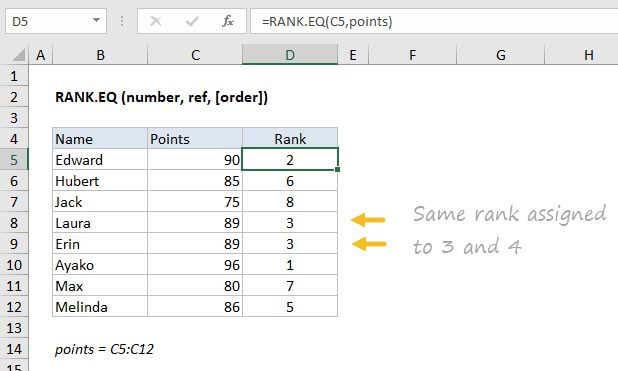
In the example shown, the formula in D5 is:
=RANK.EQ(C5,points)
where "points" is the named range C5:C12.
Controlling rank order
The rank function has two modes of operation, controlled by the order argument. To rank values where the largest value is ranked #1, set order to zero (0), or omit the order argument. To rank values so that the smallest value receives rank #1, set order to 1.
For example, with the values 1-5 in the range A1:A5:
=RANK.EQ(1,A1:A5,0) // descending, returns 5=RANK.EQ(1,A1:A5,1) // ascending, returns 1
Set order to zero (0) when you want to rank something like top sales, where the largest sales numbers should get the best rank, and to set order to one (1) to rank something like race results, where the shortest (fastest) times should rank highest.
Duplicates
When values to rank contain duplicates (ties), the RANK.EQ function will assign the higher rank to each set of duplicates. To assign an average rank to duplicates, see the RANK.AVG function.
Notes
- The default for order is zero (0). If order is 0 or omitted, the largest value is ranked #1.
- If order is 1, the smallest value is ranked #1.
- It is not necessary to sort the values in the list before using the RANK.EQ function.
- In the even of a tie RANK.EQ will assign the higher rank to each set of duplicates.