Excel CONCATENATE Function
Summary
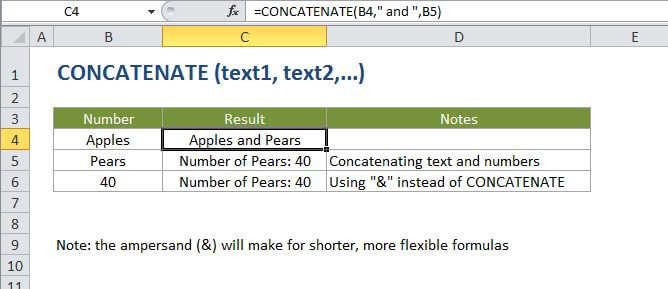
The Excel CONCATENATE function concatenates (joins) join up to 30 text items together and returns the result as text. The CONCAT function replaces CONCATENATE in newer versions of Excel.
Purpose
Join text together
Return value
Text joined together.
Syntax
=CONCATENATE (text1, text2, [text3], ...)
Arguments
- text1 - The first text value to join together.
- text2 - The seond text value to join together.
- text3 - [optional] The third text value to join together.
Usage notes
- CONCATENATE can join up to 30 text items together.
- Text items can be text strings, numbers, or cell references that refer to one cell.
- Numbers are converted to text when joined. If you need to specify a number format for a number being joined, see the TEXT function.
- The ampersand character (&) is an alternative to CONCATENATE. The result is the same, but the ampersand is more flexible, and creates formulas that are shorter and (arguably) easier to read.
Excel CONCATENATE Function

Summary
The Excel CONCATENATE function concatenates (joins) join up to 30 text items together and returns the result as text. The CONCAT function replaces CONCATENATE in newer versions of Excel.
Purpose
Join text together
Return value
Text joined together.
Syntax
=CONCATENATE (text1, text2, [text3], ...)
Arguments
- text1 - The first text value to join together.
- text2 - The seond text value to join together.
- text3 - [optional] The third text value to join together.
Usage notes
- CONCATENATE can join up to 30 text items together.
- Text items can be text strings, numbers, or cell references that refer to one cell.
- Numbers are converted to text when joined. If you need to specify a number format for a number being joined, see the TEXT function.
- The ampersand character (&) is an alternative to CONCATENATE. The result is the same, but the ampersand is more flexible, and creates formulas that are shorter and (arguably) easier to read.