Excel PV Function
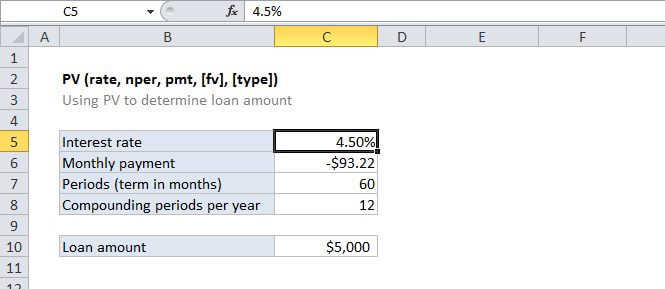
Summary
The Excel PV function is a financial function that returns the present value of an investment. You can use the PV function to get the value in today's dollars of a series of future payments, assuming periodic, constant payments and a constant interest rate.
Purpose
Get the present value of an investment
Return value
present value
Syntax
=PV (rate, nper, pmt, [fv], [type])
Arguments
- rate - The interest rate per period.
- nper - The total number of payment periods.
- pmt - The payment made each period.
- fv - [optional] A cash balance you want to attain after the last payment is made. If omitted, assumed to be zero.
- type - [optional] When payments are due. 0 = end of period, 1 = beginning of period. Default is 0.
Usage notes
The PV function returns the value in today's dollars of a series of future payments, assuming periodic, constant payments and a constant interest rate.
Notes
1. A stream of cash flows that includes the same amount of cash outflow (or inflow) each period is called an annuity. For example, a car loan or a mortgage is an annuity. When each period's interest rate is the same, an annuity can be valued using the PV function.
2. In annuity functions, cash you pay out, such as a deposit to savings, is represented by a negative number; cash you receive, such as a pidend check, is represented by a positive number. For example, a $2,500 deposit to the bank would be represented by the argument -2500 for pmt if you are the depositor, and by the argument 2500 for pmt if you are the bank.